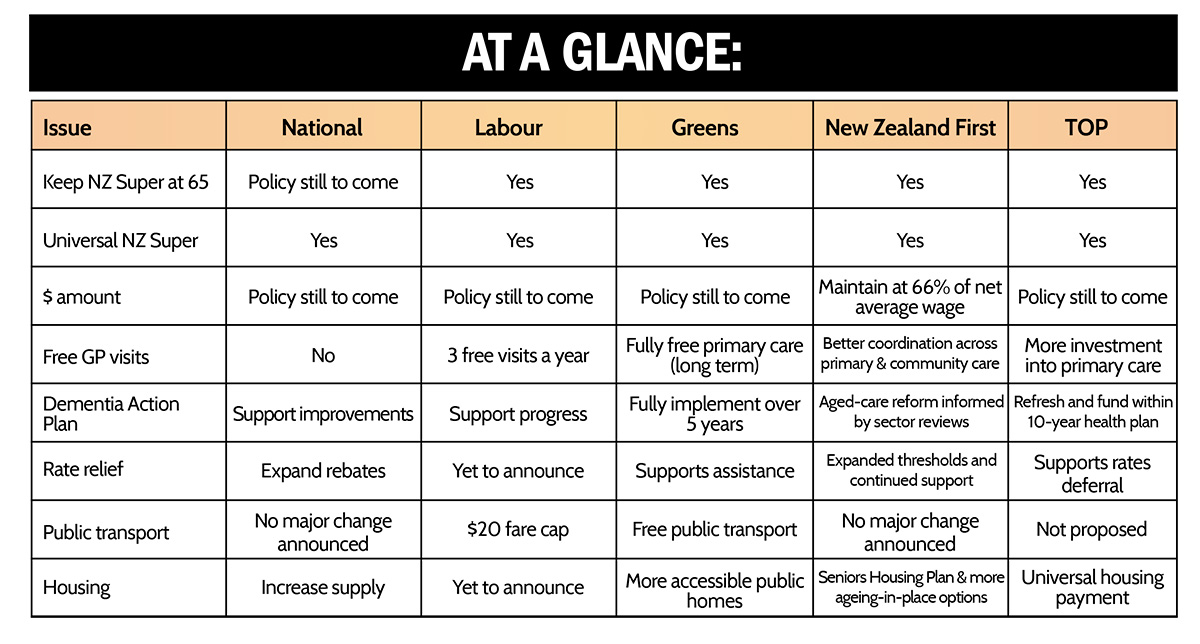
Grey Power asked the seven major political parties to outline their policies for older New Zealanders ahead of the 2026 General Election. National, Labour, the Green Party, New Zealand First and The Opportunities Party (TOP) responded.
ACT was invited to participate but said it not have the capacity to complete the questionnaire. Te Pati Maori did not respond.
The responses reveal broad agreement on protecting New Zealand Superannuation, but significant differences in healthcare, housing and cost-of-living policies.
Superannuation
Four parties — Labour, the Greens, New Zealand First and TOP — gave a clear commitment to retain the age of eligibility for NZ Super at 65.
National supports universal superannuation and will not means-test it, but did not confirm whether it will retain the eligibility age at 65, saying its full policy will be announced closer to the election.
All responding parties support universal entitlement to NZ Super regardless of income or assets. The Greens are open to exploring individual rather than couple payment rates in the future, while TOP says any longer-term changes would be part of a broader Citizens’ Income model and would not occur within the next decade. New Zealand First committed to maintaining NZ Super at 66% of the net average wage.
Health and dementia care
Healthcare is one of the clearest areas of policy difference. Labour’s flagship proposal is three free GP visits a year for every New Zealander through its proposed Medicard, alongside increased funding for general practice and support for new GP clinics.
The Greens want to move towards a fully free public primary healthcare system, including free dental care and removing prescription charges. They have also committed to fully implementing the national Dementia Mate Wareware Action Plan over five years.
TOP proposes a 10-year cross-party Health Plan to provide stable long-term funding, increase investment in primary and preventive care, and strengthen community-based services so more older people can age at home.
National points to its record of employing more doctors and nurses, funding additional medicines, increasing elective surgery and expanding cancer screening. It says its full health policy will be released later in the campaign.
New Zealand First says it supports better coordination between primary, community and aged care and identifies aged-care reform as a priority.
Housing and cost of living
All responding parties acknowledge the pressure housing and living costs are placing on seniors. National highlights expanded rates rebates, increased Accommodation Supplement payments and housing reforms designed to increase supply.
Labour has yet to announce specific senior housing policies, but has committed to a $20 cap on public transport fares and measures to reduce household energy costs.
The Greens propose thousands more accessible public homes, a state-owned, not-for-profit retirement village scheme, expanded home insulation and solar support, and limiting annual rent increases to 2%.
TOP would replace the Accommodation Supplement with a universal housing payment, support more social housing and introduce interest-free rates deferral for older homeowners.
New Zealand First proposes a Seniors Housing Plan and more options to support ageing in place.
Supporting older New Zealanders
All five responding parties support pay equity for aged-care workers, although they differ on how they would strengthen the workforce.
The Greens and TOP place particular emphasis on helping older people age in place, with more community-based health services and support for family carers.
Labour focuses on making healthcare more affordable, while National says its priorities are growing the economy, improving healthcare and keeping housing more affordable. New Zealand First has identified aged-care reform as a major priority.