Grey Power and the Disabled Older People’s Group have many advocacy issues in common covering services and respect for the wellbeing of all older people including those with disabilities. This article from the Disabled Older People’s Group offers thoughts on creating a better world for all seniors.
Who are we?
We are a group of older adults who have been disabled for most or all of our lives. We see our impairment as part of our identity. We see ourselves as disabled not by our impairment but by the environment in which we live. This is known as the Social Model.
Environmental barriers which disable and frustrate us include inaccessible physical environments such as many buildings, kerbs we cannot safely cross, and maxi (accessible) taxis often being unavailable at weekends and other times such as during school runs. As most of us were born before computers, increasingly information is also inaccessible to us.
One difference between us and people who acquire a disability only as they age, is that we have had to use enabling equipment, such as a wheelchair or braille, throughout life.
Many people – including some seniors – feel sorry for people who use a wheelchair and may think such folk have ‘given up’. The truth is, for many, a wheelchair is liberating and provides freedom.
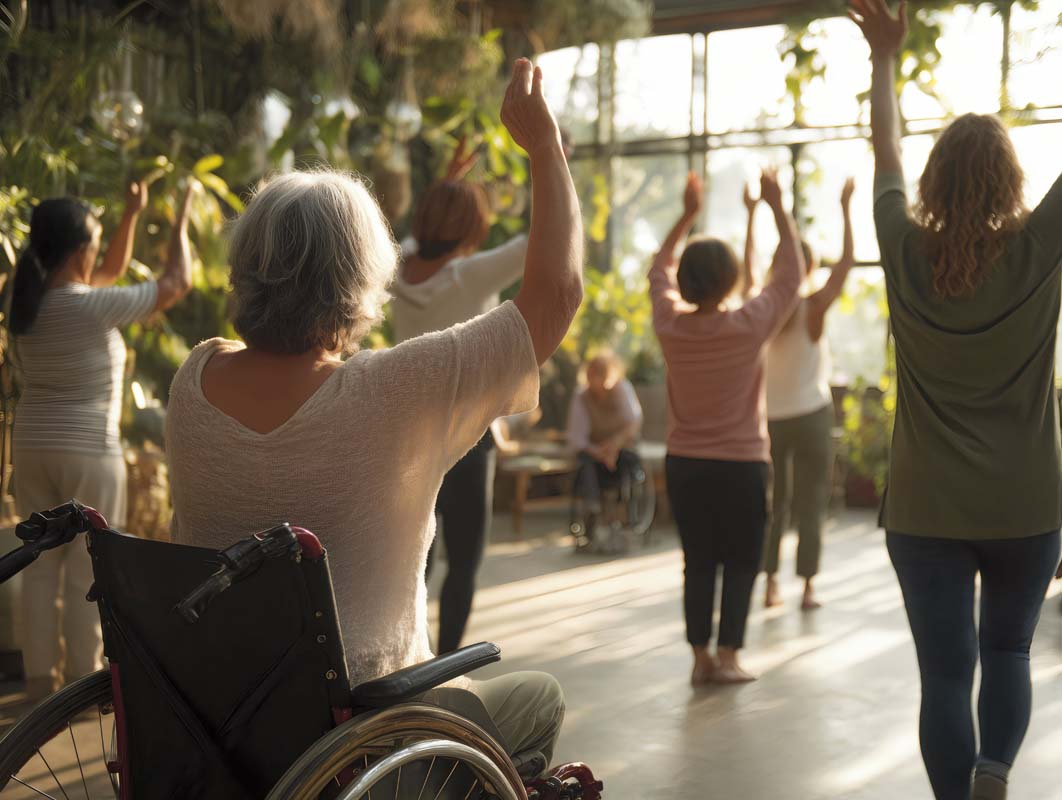
Our hands are free to do a lot more, and our risk of falls is reduced. Exercising from our wheelchair helps keeps us fit. Some of us even dance from our wheelchairs! Similarly, sign language, braille and audio description enable disabled people to live full and rich lives despite their impairments.
The impact of entering older age
As for many people, it is a bit of shock when entering ‘the third age’. We see little acceptance by the wider community of impairments being a ‘part of the human condition’. We also see many older people, who acquire an impairment, still resisting being identified as ‘disabled’.
Advertisements for lifestyle villages and retirement homes usually show everyone as fit and healthy! The reality may be very different. Disabled older people are seldom represented. The assumption is that we are not fit and healthy.
Disabled older people can also feel ‘invisible’ as we are a ‘new’ group while most others are seen as disabled children or disabled adults of working age. This ‘invisibility’ is reflected in the policy and practices around disabled people as ‘older age’ data is largely unavailable for policy makers to make informed decisions.
We want to challenge the assumption that we are unable to fully participate in society. We can participate if society is made to be inclusive and truly accessible and we are given equal opportunity to participate. We can, and do, make a valuable contribution to society.
The options which create an accessible and inclusive society are affordable. Look at Māori society – it honours its kuia and kaumatua as having knowledge, wisdom, and a valuable part to play.
Removing barriers for increased participation
As disabled older people we want to be included in society and have the right to fully participate. We want to be acknowledged and respected.
Some of the things that enable us to be included are Total Mobility (reduced taxi fares) and Operation Mobility (parking cards). Both give us equal opportunity to participate.
Reduced taxi fares make it possible for those who don’t drive or use public transport, to have an affordable means of transport. This is not just about accessing medical appointments and shopping. Being able to get out and about and to socialise easily with friends and families, helps avoid social isolation and depression.
We are concerned that the current Total Mobility fare structure is under threat. Parking cards mean our energy is not consumed by merely getting from the carpark to a shop let alone shopping. We older disabled people fought for the things which now benefit all age groups – young and old – with disabilities. However, the fight is never over. We have to fight to retain what has been attained.
Inaccessible environments and information are other significant barriers. We are not just talking about ramps although we do need to ensure ramps have the right gradient and a proper handrail.
In addition, footpaths should be safe for the blind and visually impaired and for anyone using canes, walking frames or crutches. We need good street lighting and the removal of footpath barriers which don’t allow for e-scooters.
Public transport needs to be accessible. That includes ticket purchase, getting on and off a bus or train, knowing you have the right bus or train and where to stop. Enough room to accommodate power chairs and larger mobility scooters is also required. Public and private facilities should also have a flashing alarm to alert deaf people to an emergency.
As more services go online, having accessible information is of growing importance. We know the ‘digital divide’ is significant for older people and especially for disabled older people.
Many older people don’t own a computer and those who do, often fail to make the best use of them. Some also have outdated computers and phones and no resources to replace them. What’s more, many instructions and forms have not been tested for accessibility before being sent out.
The upcoming phasing out of 3G will also leave many people without phone access. Accessibility should be part of any commissioning of digital solutions.
Gaining information is another problem. There is no central, co-ordinated agency which has both national and regional information on tap. In addition, key information is unavailable in alternate formats including NZ sign language (our third national language), braille, large print, audio description and Easy Read.
One of the greatest bug bears is the design of basic household equipment. While much equipment has digital features, such as touch screens, many are inaccessible. However, through the advocacy of the Association of Blind Citizens (ABC,) EftPos machines are now accessible to those who are blind and visually impaired. So, it can be done!
The lack of accessible housing is a major deterrent to disabled older people for remaining in their communities. Existing homes and rentals have entrances which are usually inaccessible. Narrow hallways and little room around beds are especially difficult if a person has a walker or a wheelchair. Lack of studs in bathrooms make it difficult to erect rails and showers can be inaccessible too.
If buildings complied with Life Mark design www.lifemark.co.nz/our-design-standards, it would be easier to retrofit houses to accommodate a disability or the restraints of age.
Call to action
Without opportunities and the removal of barriers, older disabled people, or seniors with age-related disabilities, cannot fully participate in society. We know the risk of social isolation and depression for both groups is very real.
However, we want to, and CAN, participate in many situations despite those barriers. So, we call on Grey Power to help remove barriers and create better opportunities to participate in society.
Help us prevent the further reduction of essential local and central government services. Help us keep the current Total Mobility access criteria and subsidies and help ensure more houses and rentals (including of Kainga Ora) are built to be fully accessible or to comply with the Life Mark standard (hence they can be easily altered).
Contact ahawker011@gmail.com or phone 0272 235 338.